What the heck does it personally mean to be a leader? To be someone who demonstrates leadership? How do you get there? What are the leadership behaviors that could impact a team in a negative manner? Is leadership a natural born trait or a developed skill? Can anyone be a leader? In this third part of the series, I want to explore the individual leadership role.
Let’s begin with confirming my definition of a leader. A leader is someone who demonstrates leadership qualities. That may sound “damn obvious” to many, but it needs to be said. Let me explain. In many cases the leader role is labeled to indicate its position and the owner’s level of organizational power that aligns with that label. The role may say Director, Senior manager, Vice President or Chief Operations Officer; and there are many more labels you could probably name; and the expectation (often just a hope) is that the person in this role demonstrates leadership qualities. As we all know, this is not always the case!
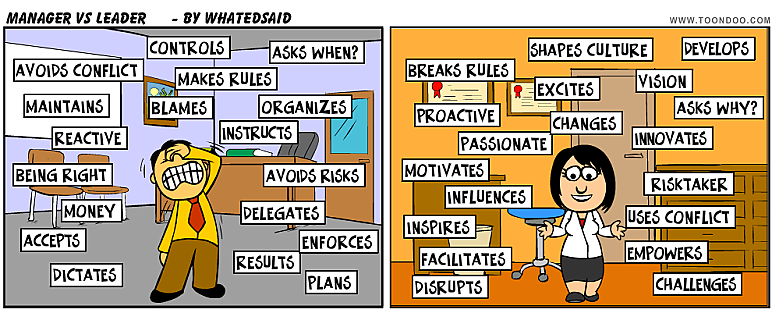
I use this cartoon when I do my CCA® program to demonstrate the difference between leadership and management and it has relevance for this post. Although I don’t agree 100% with all the statements on either side, it gives a good essence of each area. Take a moment to reflect on the words you see and how you might interpret their presence within each side.
The title of the cartoon leads me nicely into the core of my discussion: Manager vs Leader – which is your best position or role? Have you taken a self evaluation moment to consider which is your better role? You can do this simply by considering the things you enjoy doing (which are usually where you are willing to invest time). Where do these sit in the graphic or the general essence of each of these roles above? Be honest, are these management or leadership activities?
- Do you prefer to be task focused or people focused?
- Are you someone who provides guidance or likes to instruct?
- What is your natural tendency and comfort space for risk taking?
I want to make one thing very clear – ITS OK TO BE A MANAGER. Without great managers, many things would never get done. We need managers. Although I personally prefer leadership to management, its not about there being a competition to be a leader and not be a manager. The goal is not that everyone becomes a leader. Too many organizations are making this assumption and giving greater credibility to leaders and belittling the manager role, placing expectations on the manager to be a leader without the support, competence or basic alignment to the role.
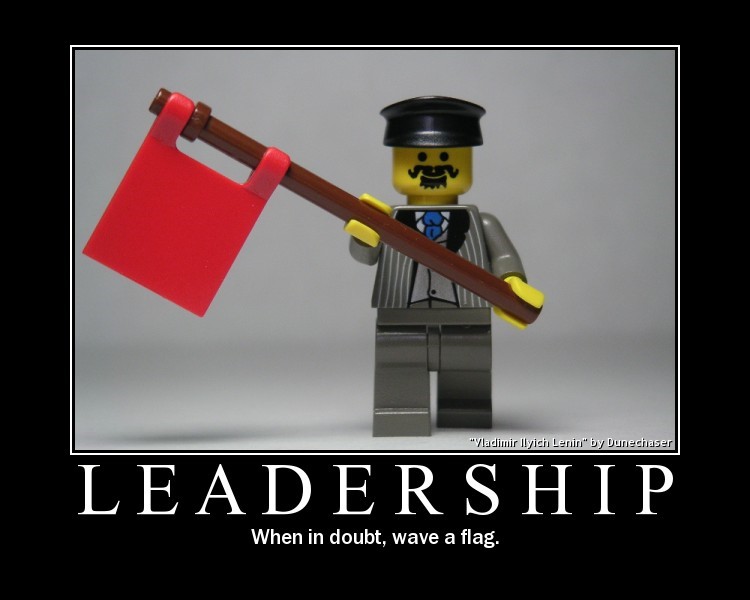 We’ve all had those eye rolling moments, when a new and/or ill-fitting leader is trying to demonstrate their forced leadership skills. It often comes via control, fear, threats and other equally negative activities. This demonstrates that they are probably natural managers who are not doing well in their new leadership position, but because of the bureaucracy of the organization around them, they are now cornered into taking this role on, whether it’s a good fit or not. They may have a myriad of leaders that also use these techniques so the only example available to them is to follow suit.
Now this is where my challenge to individuals and organizations comes into play. I ask you as the person, or you as the employer to assess leadership capability in an accurate way.
 On an individual level, this means demonstrating your Emotional Intelligence or EQ and being honest again. If you can develop sufficient self awareness you can recognize when you are doing a bad job as a leader. Recognition is not the same as responding to it. This is the time for courage, to say “this isn’t for me” and find a pathway back or forward into the managerial role you are best suited to undertake. If its not for you, then don’t go there, you will regret it. If your organization is encouraging you to go there, consider if you have the potential to move there, but need the support to get there. Which takes me to …
On an organizational level, if you recognize potential or want to move a manager into a leadership role, then you need to give them the support systems to enable their competence to grow accordingly. If they are not “leadership competent”, continuing to push forward down that pathway will make them and all around you more and more emotionally instable. Its not a good place to be and both physical and mental health will likely suffer! Develop leadership mentoring schemes, educational support programs and competency frameworks to enable the new and developing leaders to realise their potential.
My final summary comments for this post are these two statements.
- Recognize yourself as a manager or a leader and recognize each for their contribution not as a competition.
- Encourage organizations to develop their leaders, not just anoint/appoint them!
Capillary consulting offers a number of leadership development opportunities – robust programs and focused coaching opportunities. Get in touch to see how we can help you and your organization.
 As stated in my previous article, the position of leadership and the attributes of leadership are not one and the same. Many want to have the title but don’t want to take the accountability or responsibility that it requires. Discovering that they are expected to act strategically, make important decisions and retain a level of organizational authority can be a surprise to many; frequently rejecting such requirements or at a minimum, taken with immense reluctance and not very effectively. Recent news about leadership style at Uber, may be good evidence of this inability to take on this professional leadership role successfully, but I don’t want to spend paragraphs on that disaster!
 Blimps are difficult leaders to work with. They inflate themselves with self importance, feeding a need to feel vital to the organization, but see their role as more about who will do the job for them rather than doing anything themselves. They are figurehead leaders who probably have instinctive command and control approaches, and readily farm out all their real work to others, badly using delegation and empowerment as cover words for their dumping. In organizations where promotion and professional expertise is measured by appearance, sweet talking and externalized displays (peacocking) then these people quickly rise to the top. They are those that talk the talk but never walk it. There is very little that can be done to educate these people and prevention is the best cure. Preventing them requires the culture of the organization to change and that can be a whole scale change initiative in itself.
 The puppies are those that somehow landed in a leadership position. They often refer to themselves as managers or senior managers because this is where their approaches lie. They landed in a leadership position because nobody else would take it, or they got rapidly promoted within the organization, potentially because of technical or managerial skills but never assessed on leadership competency. These people can be seen as victims of being in the wrong place at the wrong time. Sometimes they are victims of lazy managers and leaders who rather than work to develop their skills, want the quick fix of “if in doubt, promote them out”. In a leadership position, they are a fish out of water. They may have some management capability, but that’s as good as it gets. Unfortunately, puppies are poorly supported, and although they may have the potential to become really great leaders, they are not given the development, mentoring or other support mechanisms and just expected to “hit the ground running”. Without true leadership development programs, these people are destined to fail.